The Lantern Boats of Willow Lane
A child sends a paper boat down the canal and finds a way for a neighbor to see it from home.
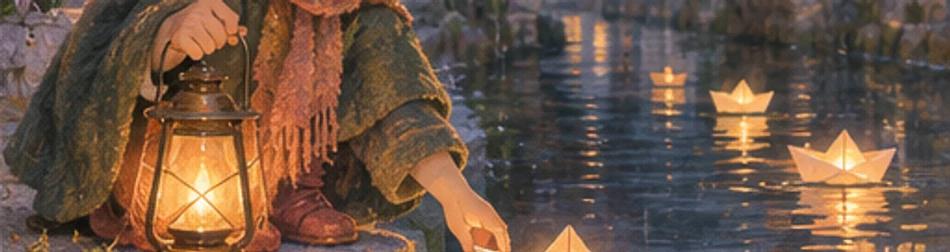
Every autumn on Willow Lane, people folded paper boats and carried them to the canal at dusk. A boat could be made from any scrap of paper. Once its two ends were tucked in, a little square of light appeared in the middle. The light would float with the boat as far as the stone bridge and go out when it passed underneath.
Sam had a stack of paper left over from a school notebook. The first boat was covered in multiplication. The second was plain except for a pencil mark where Sam had tried to draw a bird. Sam kept that one on the windowsill until it was time to go outside, because its edges had come out even.
There was an apartment above the corner shop with a window that looked down on the canal. Mrs. Vale usually watched from that window before coming down to the water. This evening her window was dark. The shopkeeper told Sam she was resting in the small room at the back. From there she could only see the alley and the top of a tree.
Sam wondered whether a boat could pass through that part of the canal. The main stream turned left at the bridge. A narrow branch went right behind the shop, but it hardly moved at all. It was where people brought their watering cans in summer. Sam and a neighbor walked round to the back step to see where the current went.
At the head of the branch, a wooden board stood upright in a slot. A thread of water leaked under it and came out on the other side. Sam’s neighbor said the board was usually lifted after the first frost to let the water run through the branch. He took a long hook down from the wall and pulled the board just far enough to clear the slot. Leaves drifted apart. The branch began to move.
Sam went back for the boats. The first boat slipped away as soon as it touched the stream. The sums were hard to read in the dim light, but there was still a bright square above them. The boat stayed in the middle until it came to a rough stone. It turned sideways and began to fill at one corner.
Sam tried the second boat farther down, where there was a calmer patch beside the wall. This time it turned slowly and came out pointing the right way. Its light was small enough to fit in the space between Sam’s fingers. Sam walked beside it, counting the steps from the stone bridge to the alley.
Under Mrs. Vale’s window, the boat hesitated. Sam could see it catching on the edge of a leaf. The neighbor slid the hook down until it touched the leaf and drew the leaf aside. The boat came loose. It passed into a narrow strip of clear water where the shop light usually reflected. That evening the shop had turned its light off early, so the boat made a bright line down the middle.
A window opened upstairs. Mrs. Vale held up a hand, and Sam held up both hands so she could see them from the water. She watched until the little light turned behind the tree. After the boat had passed, she looked down again. “I saw your bird,” she said. The boat had tilted just enough to show the pencil mark.
At home, Sam folded one more boat and set it on the windowsill. The square of light came on while Sam was turning out the lamp. By the time Sam had climbed into bed, the paper had cooled and the light had gone down to a thread. Sam could still see the fold that would open if somebody wanted to try it tomorrow. The last thing Sam heard was the neighbor setting the wooden hook back on the wall.
Give your child the starring role in a new story with this theme.
Create a story with your child’s name