The Moon in the Telescope
A child on the last observatory shift learns to find the part of the moon they came to see.
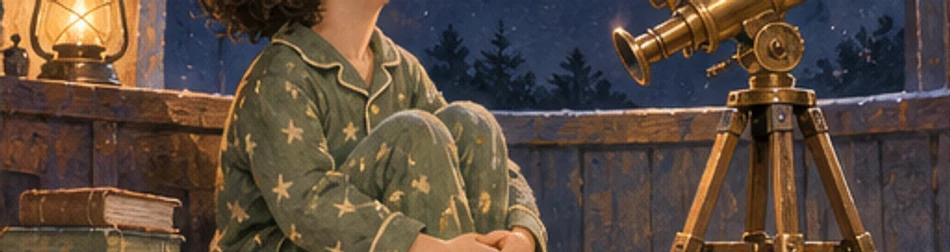
The observatory had one door that opened outward and one window that opened to the sky. On Friday evenings, Jo’s aunt swept the stairs while Jo turned the handle that opened the window. It took eighteen full turns. At the seventeenth turn there was a gap wide enough for a star, and at the eighteenth there was room for the moon.
Jo had been saving up a question all week. There was a smooth-looking patch on the moon that Jo could see from the bus stop, just beside the crooked edge. On a map it was called a sea. Jo wanted to see if it looked like the sea at home, with a pale line where it met the land and a darker bit farther out.
Jo’s aunt locked the telescope in place and stood back. In the eyepiece Jo saw a very bright piece of sky and then a blur like milk in a glass. Jo moved too fast and lost both. It felt strange to know exactly where the moon was in the room and still be unable to find it inside the little circle.
“Try the lowest power first,” Aunt Lin said. She took a smaller lens from the drawer. “You’ll see more of the sky at once.” Jo could hear a man closing the gate outside and another person laughing on the hill. The voices receded. After a minute there was only the humming of the little heater next to the stairs.
Through the new lens, Jo found a line of three bright points and then the moon. It entered from the right, moving much faster than it looked from the garden. Jo kept the hand on the telescope still and waited until the moon reached the middle. There were marks and rings and gray patches where Jo had expected mostly white.
At the edge of the bright part were tiny dark shapes. Jo thought they might be trees, but Aunt Lin showed how the dark shapes stayed close to the rings. The sunlight was coming in sideways. It was like standing outside when the kitchen light came through the doorway and made each step cast a shadow across the one below it.
The sea was there too. It looked like an old flat floor from above, with nothing on it to show how far it went. Aunt Lin said that a long time ago molten rock had spread into a low place and hardened there. People had named it a sea before they knew. Jo decided to keep calling it that. There were all kinds of things you could see in a place name if you let yourself look twice.
Before they closed up, Jo drew the shape in a notebook. The border was wrong on the first try, so Jo drew another one just below it. Aunt Lin slipped a piece of paper between the drawings to keep the pencil from rubbing off. Jo wrote a small note beside the second drawing so there would be something to look for on the next clear night.
Down at the bus stop, the moon was high above the sign. It looked almost exactly as it had on Monday. Jo could still find the patch without the telescope. A bus came up the road and the warm lights inside went past one by one as it pulled in. Jo sat on the side where the moon would stay visible longest. The notebook lay flat across both knees. By the time the bus reached their street, Jo was holding the pencil so lightly that Aunt Lin had to catch it before it rolled under the seat.
At home, Jo put the notebook where the morning light would fall across it. Then Jo lay in bed thinking of the gray sea, a place where daylight arrived and left without making a sound. There would be time to draw the other side of it another evening.
Give your child the starring role in a new story with this theme.
Create a story with your child’s name